Micro-SaaS · Solo-built, live
Linkzo
Marketers, creators & developers sharing links
A Cloudflare-native URL shortener built for speed. Links redirect from the nearest edge location worldwide in sub-millisecond time. Anyone can shorten a link with no signup; signing in unlocks a dashboard with custom slugs, QR codes, and per-link click analytics. Built and shipped zero-to-live, solo.
View live at linkzo.co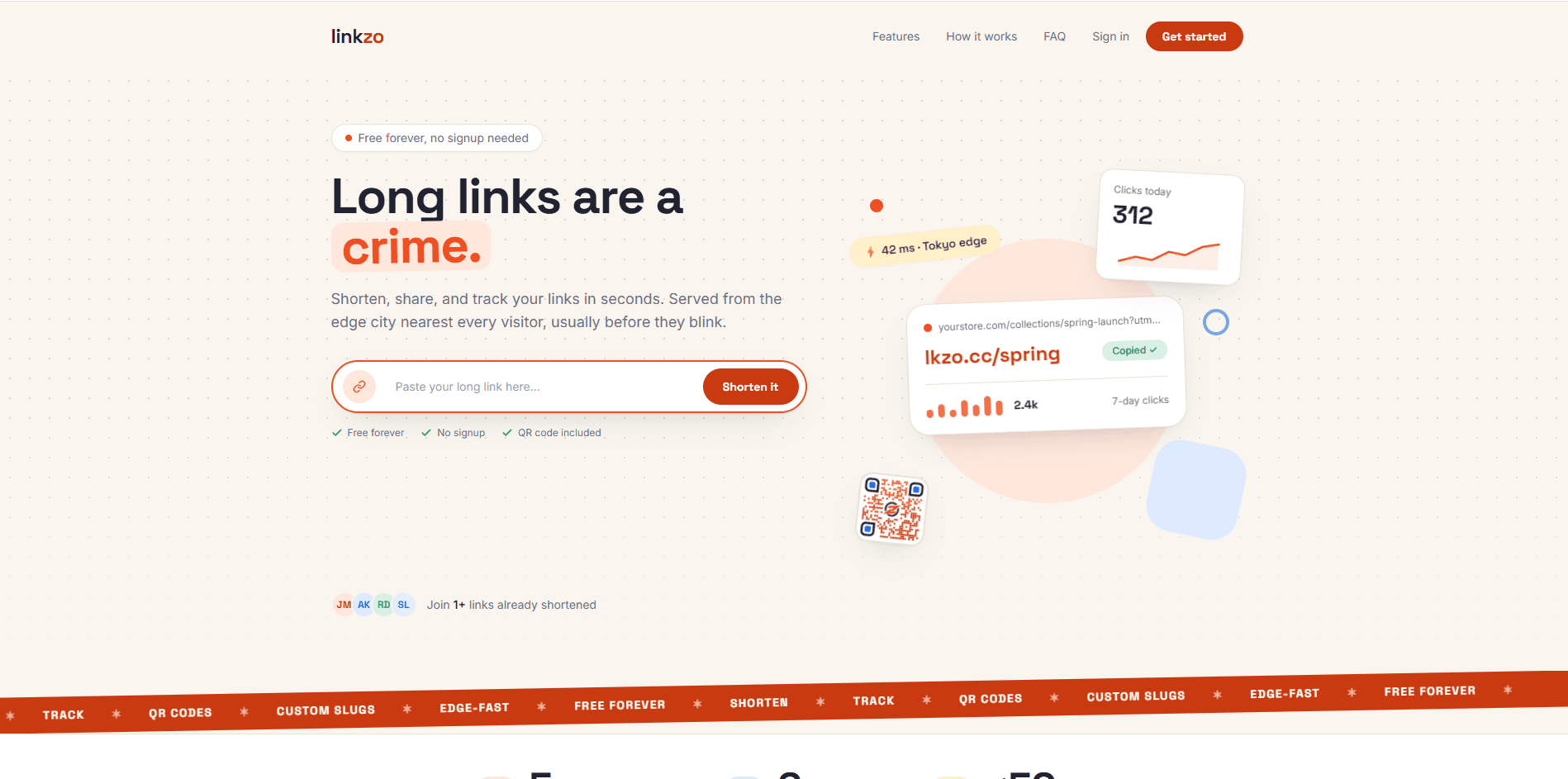
The problem
Most URL shorteners look the same and feel slow, because the redirect, the one part that has to be instant, often takes a round trip back to a central database. A link that hesitates before it resolves is a link people quietly stop trusting.
I wanted to prove an edge-native architecture end to end: a shortener where the redirect path never touches a traditional database, stays fast everywhere in the world, and still resists the abuse that every public link tool attracts.
Goals
- Make redirects resolve from the nearest edge location with sub-millisecond lookups
- Let anyone shorten a link with no signup, while keeping the tool abuse-resistant
- Unlock custom slugs, QR codes, and click analytics for signed-in users
- Keep analytics genuinely useful without being invasive about who clicked
- Ship it as a real, live product, built solo from end to end
The solution
Linkzo runs entirely on Cloudflare Workers, as a single Worker that serves both the API and the app. The redirect hot path reads the destination straight from Workers KV, which is replicated globally, so a click resolves at the nearest edge in sub-millisecond time and never blocks on a write. Click counting happens asynchronously, after the redirect has already fired.
Relational data lives in Cloudflare D1 (SQLite) through Drizzle ORM, with KV acting as a fast projection of it. The app is built with Hono and React Router v7, auth runs on Better Auth, and every input is validated with Zod. Signed-in users get a dashboard for custom slugs, downloadable QR codes, and per-link analytics powered by Workers Analytics Engine.
A sacred redirect path
The redirect reads from globally replicated KV and does zero blocking writes. Click counts and analytics events are recorded after the redirect via background tasks, so speed never depends on logging.
Useful without being invasive
Analytics capture country, device class, and referrer host only, never full URLs or raw IPs, so the dashboard is genuinely useful while staying privacy-conscious.
No-signup, still abuse-resistant
Anyone can shorten a link without an account, guarded by URL safety checks, per-IP rate limits, a reserved-slug blocklist, and optional Safe Browsing.
What it does
- Edge redirects worldwide via Workers KV, a sub-millisecond hot path
- Shorten instantly with no signup; sign in to manage and track
- Custom slugs on the dedicated lkzo.cc short domain
- A QR code per link, downloadable as PNG or SVG
- Per-link analytics: clicks over time, top countries and referrers
- Abuse-resistant: URL safety checks, rate limits, reserved slugs
Challenges
Speed as an architecture decision
Hitting sub-millisecond redirects meant treating KV as the hot path and D1 as the source of truth behind it, then keeping the two in sync on every link change rather than reading the database on the critical path.
Open to the public, hardened by default
A free, no-signup link tool is a magnet for abuse, so safety checks, rate limiting, and reserved slugs were part of the core design rather than a later patch.
Results
Linkzo is live, with the app on linkzo.co and short links served from a dedicated lkzo.cc domain, both running on a single Cloudflare Worker at the edge.
It proves an edge-native shortener can be fast everywhere, abuse-resistant, and genuinely useful to track, without a traditional always-on database sitting on the redirect path.
Outcome · A fast, abuse-resistant URL shortener running entirely on Cloudflare's edge, designed, built, and shipped end to end by one developer.
Tech stack
What I took from it
On a latency-critical path, architecture is the feature. Choosing KV for reads and keeping the database off the hot path mattered more than any individual line of code.
Anything you open to the public for free needs its abuse defences designed in from the start, because they are far harder to retrofit once links are already live.